It started as a simple catch-up, the kind where you offer a listening ear. She was exhausted, caught in a cycle of relentless self-criticism and a perfectionism so extreme it had become self-destructive. As she described her childhood, an environment steeped in high expectations where nothing was ever quite “enough”, it clicked. This is something I also experienced. I would say that almost any physician’s child has. She had perfectly internalized her external critics. The perfectionist voices of her past had taken up permanent residence in her own head.
But as our conversation deepened, the chat transformed into a session on the biology of stress.
I know that this kind of chronic self-flagellation isn’t just a psychological burden; it’s a physiological loop. We were looking at a textbook, runaway HPA axis. This biological basis helps very rational people a lot to understand the power of psychology, without the need for a drug to see a tangible result.
Here is how a conversation about childhood expectations led to a neurobiological breakdown, a cathartic breakthrough, and a simple daily tool to quiet the mind.
The Biology of the Inner Critic
To understand why chronic self-criticism feels so exhausting, you have to look at the HPA axis, the Hypothalamic-Pituitary-Adrenal axis. This is the body’s central stress response system.
Think of it as an alarm system designed to save you from a tiger. The problem is, the brain struggles to tell the difference between a physical predator and the psychological threat of “not being good enough.”
Here is how the loop works when the inner critic takes over:
- The Hypothalamus (The Smoke Detector): Deep in the brain, the amygdala detects a “threat”, in this case, an internal thought like I failed, I’m an imposter. The hypothalamus reacts instantly, releasing a hormone called CRH.
- The Pituitary Gland (The Dispatcher): Sitting just below the hypothalamus, the pituitary gland receives this signal and releases another hormone, ACTH, into the bloodstream, shouting to the rest of the body to prepare for an emergency.
- The Adrenal Glands (The First Responders): Sitting on top of your kidneys, these glands receive the ACTH and flood your system with cortisol (and adrenaline).
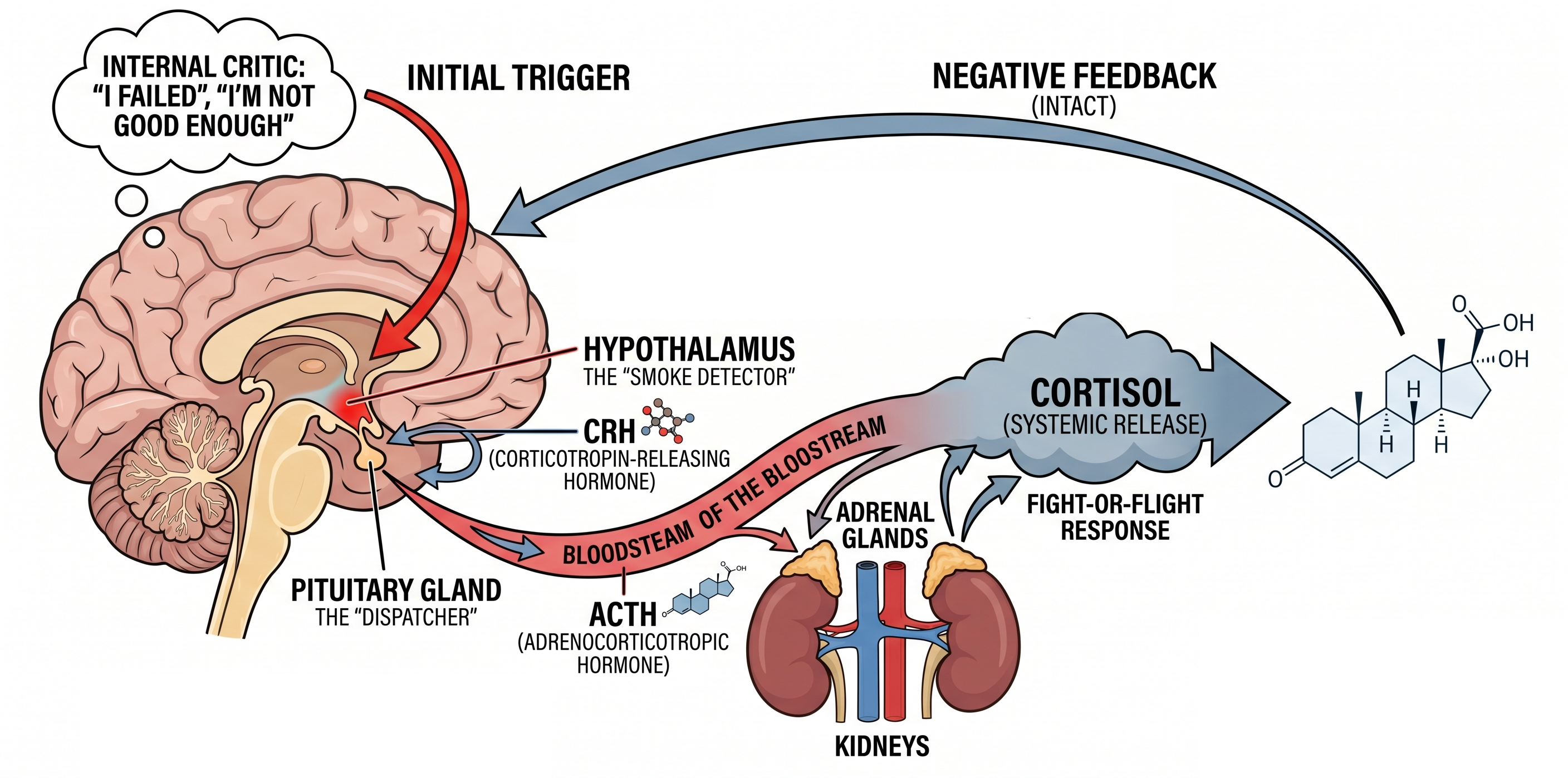
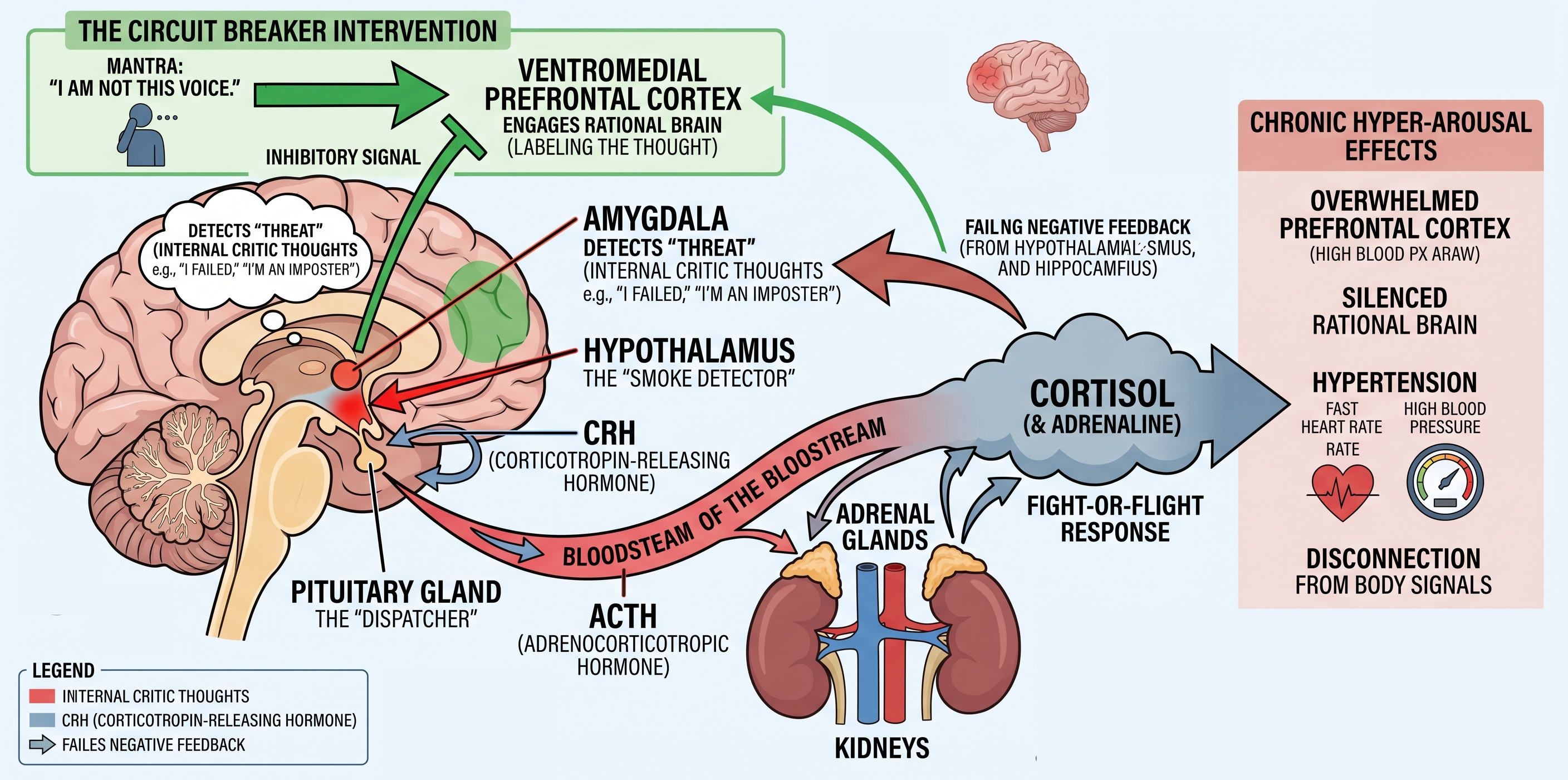
When you are constantly criticizing yourself, you are keeping your finger glued to the panic button. The HPA axis becomes hyper-reactive. The amygdala stays in overdrive, scanning for mistakes, while the prefrontal cortex, the rational part of the brain that should be saying, “Hey, it’s just a typo, relax”, gets overwhelmed and silenced by the constant flood of stress chemicals.
You end up in a state of chronic hyper-arousal, which can lead to everything from hypertension to a total disconnection from your body’s basic signals (like forgetting if you are hungry, thirsty, tired, or even amenorrhea due to inhibited GnRH release, which is the case).
Breaking the loop
Understanding the biology is fascinating, but how do you stop the loop? You can’t just tell an overactive amygdala to calm down.
During our deep dive, we hit upon a strategy rooted in cognitive restructuring. We needed a circuit breaker, a way to manually override the HPA axis before the cortisol flooded the system.
The tool we landed on was deceptively simple. A single, mantra-like sentence to be repeated the second the self-criticism flared up:
“This is my inner critic speaking, not an objective fact.”
Or, even simpler:
“I am not this voice.”
This isn’t just a fluffy self-help affirmation; it’s a neurobiological intervention. Isn’t this cool? We are able to trigger the generation or inhibition of the stimulus that generates the peptides that get us into a situation. We generate our own medication in the body.
When you pause and label the thought (“This is just the critic”), you actively engage the ventromedial prefrontal cortex. This rational part of the brain then sends an inhibitory signal to the amygdala. In a matter of seconds, you start dampening the panic response. You intercept the signal before the hypothalamus can launch the full cortisol cascade.
The Catharsis
When my friend understood that her anxiety and self-doubt weren’t personal failings, but rather a biological alarm system stuck in the “ON” position due to outdated childhood programming, there was a profound moment of catharsis.
She wasn’t broken. She was just running an old neurobiological programming on a loop.
She took that single sentence, “I am not this voice”, and turned it into a daily tool. Now, whenever the familiar spike of perfectionism hits, or the internal voice starts demanding the impossible, she uses the mantra. It doesn’t instantly erase the stress, but it creates a wedge. It creates just enough space to stop the HPA axis from running away with her day.
We can’t always change the environments that programmed us, but by understanding our biology, we can reprogram how we react to them today.